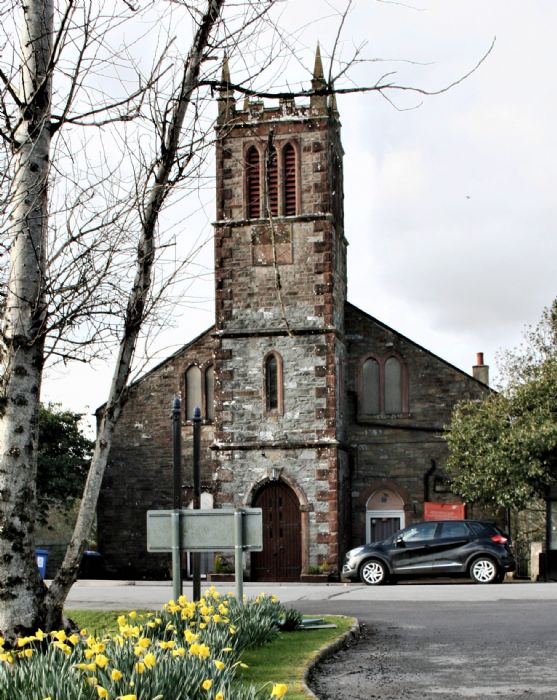
The whinstone (freestone) came from Ardwall Island (Laurie's Isle) in the Fleet Estuary. The bay where the stone was loaded onto a barge to be taken from the island is still known as Free Church Bay. The sandstone lintels came from the Castramont Burn above Culreoch Cottages. It is believed that the original building may have had a single peaked roof. This proved unstable so pillars were extended from ground level up to the eaves to support a roof with two smaller peaks. The ground floor doors opened onto the street beside the bridge while a basement area opened onto the river bank.
The church was formerly opened by Rev Mr McAuley of Donaghadee on 8th December 1844. According the Dumfries & Galloway Standard 11th Dec 1844, the building was designed to house 500 people.
The bell, which is inscribed 'David Burges - Founder - Glasgow 1841' which was used in the tower of the church was cast in 1841 and was originally was in the nearby Birtwhistle Cotton Mills to signal workers when to start and finish their days work. About 1850, after the mill was destroyed by fire, the bell was installed in the Free Church tower.
Inside, the church had a simple design. As well as the usual pews there were box pews to the right and left of the pulpit - the minister's family having one, and the Ardwall estate, who supported the Free Church had another.
The Free Church of Scotland.
Building the Church
The land used for the new church was on the Girthon bank of the River Fleet, beside the Fleet Bridge, close to the boundary between Anwoth and Girthon parishes.
The foundation stone was laid on 24th April 1844 by Rev. Samuel Smith form Borgue.
Unusually the church was built on a north/south axis - usually churches face east/west.
The whinstone (freestone) came from Ardwall Island (Laurie's Isle) in the Fleet Estuary. The bay where the stone was loaded onto a barge to be taken from the island is still known as Free Church Bay. The sandstone lintels came from the Castramont Burn above Culreoch Cottages. It is believed that the original building may have had a single peaked roof. This proved unstable so pillars were extended from ground level up to the eaves to support a roof with two smaller peaks. The ground floor doors opened onto the street beside the bridge while a basement area opened onto the river bank.
The church was formerly opened by Rev Mr McAuley of Donaghadee on 8th December 1844. According the Dumfries & Galloway Standard 11th Dec 1844, the building was designed to house 500 people.
 The bell, which is inscribed
'David Burges - Founder - Glasgow 1841'
was used in the tower of the church. It was cast in 1841in a foundry in the Gorbals, Glasgow. It was commissioned by James Davidson, the then owner of the large cotton mill nearby. It was used to signal workers when to start and finish their days work. About 1850, after the mill was destroyed by fire, the bell was installed in the Free Church tower. Now it hangs in the Ochre Gallery.
Inside, the church had a simple design. As well as the usual pews, there were box pews to the right and left of the pulpit - the minister's family having one, and the Ardwall estate, who supported the Free Church, had another.
 The Free Church of Scotland preferred simple services and a strict religious code, including fast days. Only psalms from the Old Testament were 'sung' unaccompanied. It was not until after 1900, when Rev. McGlashan was minister, that the congregation voted to allow singing of hymns in the church, but without musical instruments.
Locally people who attended this church were known as 'The Wee Frees'.
In 1849 the Free Church asked for tenders to build a manse for the minister. The house was built at the west end of the town at Planetree Park, now a private house called ‘Rutherfurd’.
|
|
The Free Church organised schools for the children of their parishioners. In Gatehouse it is believed that 'The Bland Female School' which opened on Dromore Road in 1866, was a Free Church School. The school building and headmaster’s house have now been demolished but the plaque is on a wall nearby. (We do not know of a person called Bland who sponsored the school) A boys’ school was probably housed in the other half of the same building. David Clark, the Free Church School headmaster, was living in the schoolhouse in the 1871 Anwoth census. The schools closed when they joined with Anwoth Parish School in 1872. |

See section on David Clark - click here
http://www.gatehouse-folk.org.uk/dynamic.asp?ID=102, then choose David Clark
In 1900 the United Presbyterian Church, which used the church building on Dromore Road, known locally as the Wee Kirk, joined with the Free Church of Scotland to form the United Free Church of Scotland.
 For about 5 years the 2 congregations seemed to continue to worship in separate buildings - the Anwoth people continued in their Dromore Road Church, the Girthon people in the Free Kirk, known now as Girthon United Free Church.
In 1905 about 55 members of the Anwoth Free Church joined the 80 Girthon United Free Church members. This new church became known as Rutherford Church with the joint congregation using the Free Church building. Rev. McGlashan was still the minister.
Rev. Robert Blackstock McGlashan was the last minister of the church. His gravestone at Anwoth states that he was minister of Girthon and Anwoth U.F. Church, latterly Rutherford Church, for 48 years.
In 1929 the Free Church of Scotland and the Church of Scotland resolved their differences and again joined forces. However, in Gatehouse this did not happen until after the death of Rev. McGlashan. The Free Church closed in 1931, the congregations joining with either Anwoth or Girthon Church of Scotland congregations.
Ministers of the Free Church of Girthon & Anwoth
1843 - 1844 : Rev. Robert Jeffrey.
Rev. Jeffrey was minister at Girthon Parish Church from1818 but left to join the new Church movement in 1843 after the Great Disruption. He died before his new church building was started but was told that a site had been found just before his death on 9th March1844.
|
|
Scroll plaque from the Free Church |


1844 - 1848 : Rev. Robert Maxwell Hanna
Rev. Hanna was from Ards, Ireland and was ordained on 12th June 1844, the same day as the foundation stone of the Free Church was laid. He was not in good health - he probably had tuberculosis. In 1846 he was advised to spend time in a milder climate, so he travelled to Italy to recuperate. He returned to Scotland in 1848, but it was clear that he would be unable to continue his pastoral duties. He bade farewell to the congregation in October 1848 and returned to Italy where he died in Florence on 31st December 1857.
1849 - 1892: Rev. John Robertson was ordained in March 1849. Rev Robertson was 29 years old and married Jane Paul in 1858. He was minister of the Free Church for 33 years and died in Edinburgh on 29th May 1882.
1883 - 1931: Rev. Robert Blackstalk McGlashan.
|
|
Rev. McGlashan was appointed minister in early 1883. In 1886 he married Mary Bardsley from Paisley. The couple had six children. Rev. McGlashan was the last minister of the church which closed after his death in 1931.
|
|


Rutherford Hall
By 1935 the building was no longer required as a church, so the Free Church building was converted for use as Girthon Church Hall and was renamed as the Rutherford Hall.
The architect for the conversion was Alexander Young from Newton Stewart. Local tradesmen T.H. McGaw carried out the masonry work, Smith & Murray the joinery work and Peter Jardine the plumbing. To finance the work, the Kirk Session sold the Free Church Manse to Mary McGlashan, widow of the minister. For many years the house remained in the McGlashan family. It is now called 'Rutherford'.
The main part of the church was converted into a hall with a stage at one end. The pillars remained which hindered some usage e.g. badminton was not possible.
Ladies and gents toilets and cloakrooms were added inside the main front door.
In the basement there was a kitchen, a meeting room and another room which had a billiard table. The basement was accessed by stairs on either side of the stage or by doors leading directly to the outside on either side of the building.
There was also a trap door in the floor of the main hall with steps to the basement. PC Jock McClymont, who had been a boxing champion, had training equipment in the basement.
During the years of the Second World War (1939 -1945), the building was let to the Stewartry Education Department to provide extra accommodation. The Gatehouse School roll expanded greatly during the war years, with many evacuees attending the school. Several teachers also came from Glasgow to help educate these children. Various year groups were taught in the Rutherford Hall as well as a dining hall facility for school lunches.
|
In 1946 the war memorial plaque to men from Girthon & Anwoth Free Church who had fallen in World War I. This was later removed and re-hung in Girthon Parish Church. |
|

In 1950 the Rutherford Hall was redecorated – about the time that a new minister Rev. J.B. Montgomery came to Girthon Parish.

1952 Girthon Sunday School
In 1954 there were 86 children attending Sunday School in the Rutherford Hall and 9 older children at Bible Class. There were also Sunday evening meetings arranged by Jack Patterson with help from Miss Scott and Dr. Russell.
In 1962 the Church of Scotland decided to sell the Rutherford Hall and build a small hall next to Girthon Church, although this took a few years to actually happen.
Rev. Lynch, the Roman Catholic priest was interested in buying Rutherford Hall. Gatehouse Roman Catholics had been meeting upstairs at 10 Catherine Street for many years but the plan to buy the Rutherford Hall fell through.
Downstairs the meeting room was used by the Women's Guild, another church organisation.
Occasionally concerts were also held – such as Nativity Plays performed by the Sunday School and choir although the stage was not ideal as there was no backstage.
After the war years other organisations also used the hall - Boy Scouts and Cubs, Girl Guides and Brownies, the play group, dancing classes, choir practices and carpet bowlers were all regular users. It was used for meetings, dances, sales of work, jumble sales, and occasionally the Gatehouse Horticultural Show especially after the Town Hall was closed in 1972 on safety grounds. At one dance the ‘Bay City Rollers’ were the star attraction – before they became more widely known.
For many years during Gala week, an exhibition of local artwork took place.
During this period Jim Campbell or Henderson (Slim Jim) was the hall keeper.
For several years Anwoth Books – a second-hand book shop used the space before it moved the top floor of The Mill on the Fleet.
In 1970 the building was given listed building status.
In early 1981 the Kirk Session offered to sell the Rutherford Hall to the Community Council but the offer was declined as the they knew that the old Gatehouse School building would soon be available and would be a more suitable site for a Community Centre.
|
|
On 1st April 1981, antique dealers Roger and Lyn Hampshire bought the building. They converted it into 3 flats – 2 at the rear of the building (East & West Gables) and a Tower flat accessed via the original front door. There is also a flat in the basement.
The conversion also included 2 shop units at street level at the front of the building.
|

During the early 1980s, the Hampshires sold antique furniture and smaller items from the hall until business called Roger back to London where he traded from a shared warehouse in Bermondsey. Lyn had been working as a reporter on the Galloway Gazette and in 1987 her journalistic career took her to south Wales.
|
Over the next few years the shop units were let to various businesses: bedding, new pine furniture, wholefoods, a café and latterly Anwoth Books, a secondhand bookshop which occupied Unit 2 for several years before moving to the top floor of the Mill on the Fleet. In the early ‘90s, changed circumstances brought the Hampshires back to Gatehouse and the hall became once again an antiques shop, also selling new garden ornaments. The photo shows Roger Hampshire with some of his wares garden ornaments. |
|

In 1994 they created an exhibition within Unit 2. Called “As We Were”, this recreated Galloway life of a century before. The brochure about the “As We Were” exhibition is reproduced here:-
http://www.gatehouse-folk.org.uk/userfiles/files/Special%20Buildings/Rutherford%20Hall/As%20We%20Were2.pdf
With their family grown up and the antiques trade having contracted generally due to changing fashions, the Hampshires were finding Rutherford Hall (and their basement flat there) too large for their requirements. In 2004 they had a dividing wall built, splitting the building and enabling them to sell the rear section. The rear part was bought and redesigned into two houses by brothers Gavin and Craig Reid who, as Reid Country Retreats, ran them as holiday lets for the next decade. The houses, known as East Gable and West Gable, are now residential.
In 2005, family matters called the Hampshires back to Kent, although they returned to Gatehouse as often as business allowed. The shop units, now a more manageable size, were let to Franca Bruno, whose retail outlet became a popular source for her self-made jewellery as well as other crafts and clothing. Pastures new called to Franca and in 2019 her shop was replaced by “The Crafty Crow” which was run by Kerry Anne Orr and Billy Skinner. Unit 1 was a vegan cafe, specialising in home-made pizzas, while Unit 2 housed their stock of haberdashery and craft items.
|
Lyn & Roger Hampshire with Franca Bruno |
Billy Skinner and Kerry Anne Orr |


Since 2025 the shop unit nearest the river has been the Ochre Gallery and Studio, run by local artist Richard Brinley. Unit 1 has become Ice Dreamz, an ice cream parlour run by the owners of the nearby Ship Inn.
|
|
|


Flooding
Over the years the Rutherford Hall has been prone to flooding due to its proximity to the River Fleet, Here are 2 extreme situations.
|
1940s |
1954 - 29th October |

